
 Русский
 English
 Deutsch
 Français
 Español
 中文
中文 한국어
한국어 Türkçe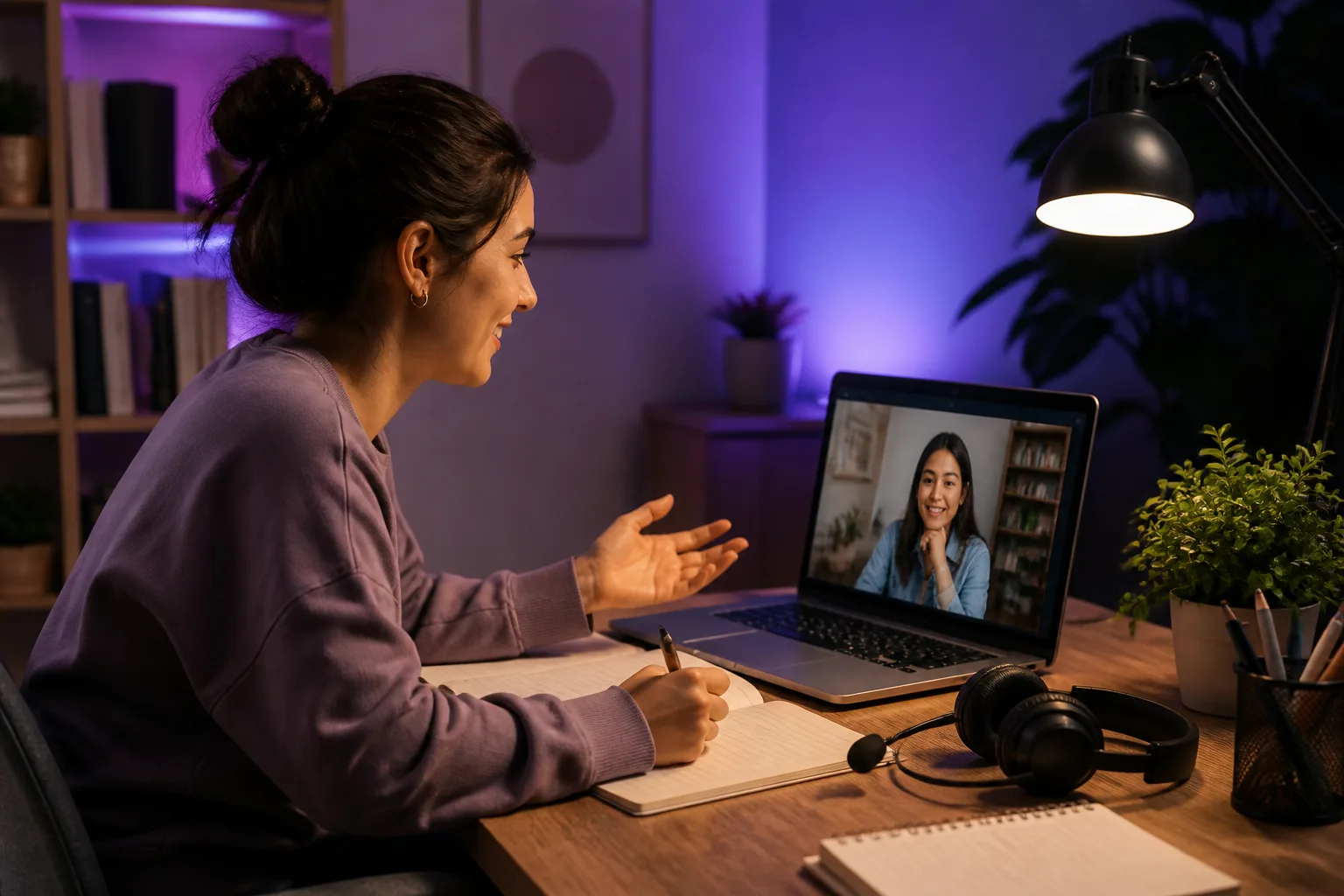
Why You Can Start Teaching Right Now
If you speak a foreign language fluently, you already have the main resource for teaching. Pedagogical experience is a skill that develops with practice. Start with your first lesson, and with each class you will feel more confident.
Many successful teachers started without special education. Your knowledge of the language, sincere desire to help, and willingness to learn are what really matter. In this article, you will find concrete steps to help you conduct your first online lesson so that both you and your student are satisfied.
Technical Checklist: Prepare Everything in Advance
Technical glitches are a common cause of stress during the first lesson. To avoid surprises, go through the list an hour before the class.
Equipment and Connection
- Laptop or computer — it is more convenient to work on than a phone.
- Stable internet — check the speed on Speedtest; it should be at least 10 Mbps.
- Headset with microphone — it will improve sound quality and eliminate echo.
- Charger — plug it in in advance.
Programs and Materials
- Video conferencing platform — Zoom, Skype, Google Meet, or specialized services for lessons. Make sure you know how to share your screen.
- Interactive whiteboard — Miro, Jamboard, or simply a Google Docs document. Prepare the board in advance: write the topic, add pictures and tasks.
- Teaching materials — select 2-3 exercises you will use. These can be tasks from open sources or your own.
- Backup plan — save files and links in the cloud or on your desktop so you can quickly open them in case of a failure.
Test Connection with the Student
Arrange a test call a day or a few hours before the lesson. Check if you can be heard, if the video is visible, and if screen sharing works. This will take only 5 minutes but will save you from much worry.
Remember: even if something goes wrong, you can switch to an audio call or send materials in the chat. Calmness is more important than perfect technology.
How to Prepare for the Lesson: A Step-by-Step Strategy
Once the technical part is ready, move on to the content. A clear plan is your anchor that will reduce anxiety and give structure to the lesson.
Define the Goal of the Lesson
Ask the student what goal they want to achieve. It could be conversational practice, interview preparation, grammar study, or exam preparation. The choice of topics and tasks depends on the goal.
Create a Lesson Plan
For the first lesson, a universal structure that you can adapt along the way works well. Write the plan on a piece of paper or in a separate document — this will make you feel more confident.
Prepare Materials
Choose 2-3 short exercises that match the student's level. For example, for level A2, tasks like describing pictures are suitable; for B1, discussing news; for B2, a discussion on a current topic. Do not overload the lesson: better less, but better quality.
Think Through Backup Options
If a task finishes faster than expected, or the student does not like an exercise, you should have a plan B. Prepare a few additional questions or a short game to fill the pause.
Structure of a 60-Minute Lesson
A classic online lesson lasts 60 minutes. Break this time into blocks to keep the lesson dynamic and not tiring.
1. Introduction and Warm-up (5–10 minutes)
Start with a light conversation: ask how the day went, what the student did on the weekend. This helps create a friendly atmosphere and get into the language mode. You can use the question "What do you see in the picture?" or "What are your plans for the week?"
2. Check Expectations and Goals (5 minutes)
Ask why the student wants to study, what their goals and expectations are. This will help you adjust the program and show that you are interested in their progress.
3. Main Part (35–40 minutes)
This is the heart of the lesson. It should include:
- Introduction of new material — explain a grammar rule or introduce new vocabulary. Use real-life examples.
- Practice — do exercises: fill in the blanks, make up a dialogue, answer questions. Let the student speak 70% of the time.
- Interaction — use the whiteboard, pictures, videos, or online games to diversify the lesson.
4. Consolidation and Feedback (5–10 minutes)
Ask the student to briefly summarize what they learned. Give feedback: point out successes and gently indicate errors. For example: "You used the new vocabulary well, but pay attention to the word order in questions."
5. Homework and Closing (5 minutes)
Give a small assignment for reinforcement: write a few sentences, watch a video, or do an exercise. Say goodbye and agree on the next lesson.
Examples of Tasks for the First Lesson
Here are some universal tasks that are suitable for the first lesson and do not require special preparation.
For Levels A1-A2
- "Tell me about yourself" — the student answers questions: name, city, job, hobbies. You note down errors.
- "Describe the picture" — show a photo (e.g., a street or a room) and ask to describe what is happening.
- "Make up a dialogue" — suggest a situation (in a cafe, at the airport) and act out a dialogue.
For Levels B1-B2
- "News of the day" — choose a short news item and discuss it, asking questions.
- "Debate" — propose a statement (e.g., "Pets should live in an apartment") and ask to argue the opinion.
- "Story from pictures" — show a series of pictures and ask to compose a story.
For Levels C1-C2
- "Article analysis" — give an article from a magazine and discuss it, paying attention to complex structures.
- "Role play" — simulate a complex situation (negotiations, interview) and play roles.
- "Timed essay" — give a topic and ask to write a short essay in 10 minutes, then discuss.
How to Cope with Anxiety Before the First Lesson
Nervousness is a normal reaction. Here are a few techniques to help you calm down.
Preparation Is Your Best Friend
The better prepared you are, the less anxious you feel. Make a plan, prepare materials, check the technology — and you will feel more confident.
Breathing Exercises
5 minutes before the lesson, take a deep breath in for 4 seconds, hold for 4 seconds, exhale for 6 seconds. Repeat 5-10 times. This will lower cortisol levels and calm your nervous system.
Positive Affirmations
Remind yourself: "I know the language, I can share knowledge," "Mistakes are experience," "The student is also nervous." Replace negative thoughts with supportive ones.
Start with a Smile
A smile not only creates a pleasant atmosphere but also sends a signal to the brain that everything is fine. Greet the student with a smile — and your tension will decrease.
Remember You Are the Expert
You know the language better than the student, and that is your main advantage. Even if you do not know how to explain a rule, you can find the answer together — that is also valuable experience.
Your task is not to be a perfect teacher, but to be a useful guide into the world of language. The student values your support more than flawless technique.
Actions After the Lesson: Reinforce Success
The lesson is over — but the work is just beginning. Proper actions after the class will help you improve your skills and retain the student.
Send a Lesson Summary
Within 2-3 hours after the class, write the student a brief summary: what you covered, what mistakes they made, what needs to be reviewed. This shows your engagement and helps the student consolidate the material.
Conduct Self-Analysis
Write in a diary or notes: what went well, what caused difficulties, what can be improved. For example, you noticed that the student had difficulty with listening comprehension — so add more listening practice in the next lesson.
Ask for Feedback
Ask the student what they liked and what should be changed. This not only helps you grow but also shows the student that you care about their comfort.
Plan the Next Lesson
Based on feedback and self-analysis, prepare the next lesson. Consider the student's pace and interests. Gradually, you will be able to create more complex and interesting classes.
Conclusion
Your first online lesson is an important step in your teaching career. Even without pedagogical experience, you can conduct it confidently if you prepare well, follow the structure, and remember that your main goal is to help the student. Do not be afraid of mistakes; treat them as opportunities to learn. With each lesson, you will get better and better, and soon teaching will become a natural and enjoyable activity for you.